

A brand blueprint is the complete record of your brand’s strategic decisions — purpose, positioning, personality, voice, and core messaging — held in one place and built to be used.
Most brands have pieces of this scattered across documents, decks, and old briefs. Some decisions were made explicitly. Others were made by default — through early design choices, inconsistent copy, or campaigns that pulled in different directions.
A brand blueprint changes that. Every decision gets made deliberately, recorded in sequence, and connected into a foundation that holds.
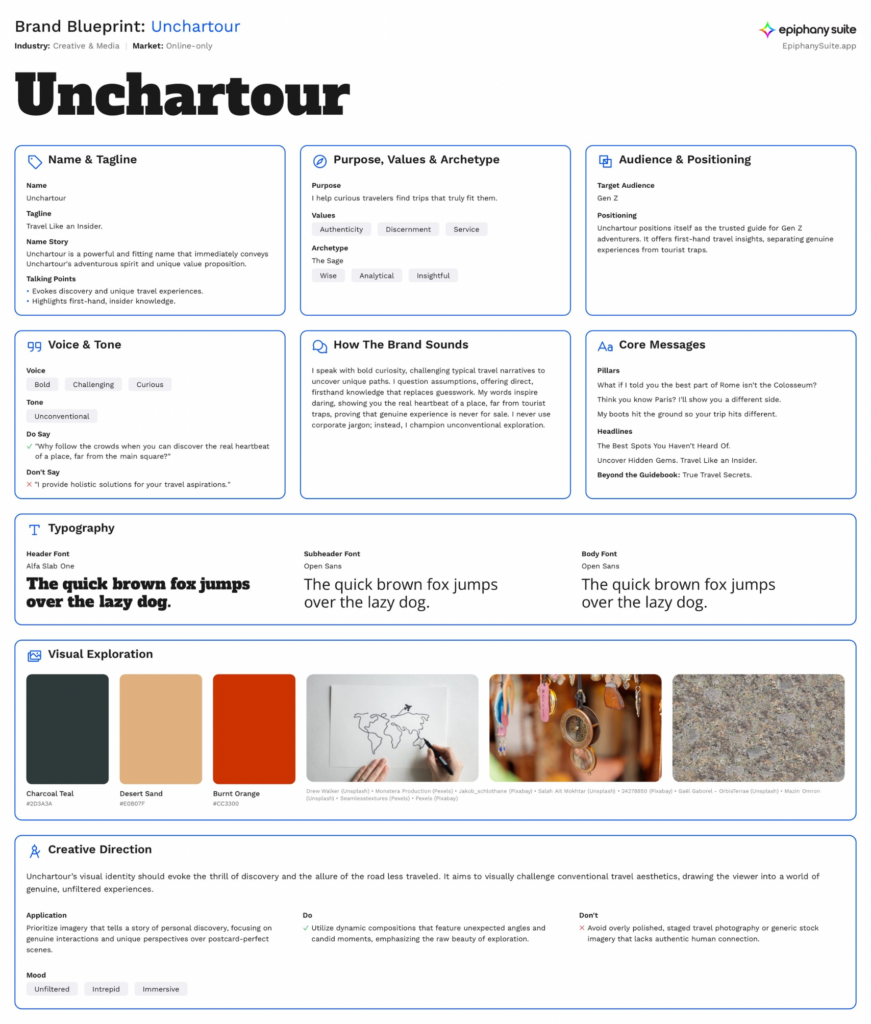
What a brand blueprint includes
A brand blueprint is not a brand guide. Brand guides document visual rules — colors, fonts, logo usage. A brand blueprint documents the strategic decisions that visual rules should express.
Five layers make up a complete brand blueprint:
Purpose and values. Why the brand exists, what it believes, and what it stands for beyond the product or service it sells. Purpose is the anchor — the decision that every other decision traces back to.
Positioning. Who the brand is for, where it stands in its market, and what makes it different in a way that matters. Clear positioning is what separates a brand that resonates from one that tries to appeal to everyone.
Brand personality. The consistent character the brand expresses across every surface. Personality makes creative decisions evaluable — not just a matter of taste, but a matter of fit.
Voice and tone. How the brand communicates — the character that stays constant and the tone that adapts to context. Voice is what makes a brand sound like itself regardless of who wrote the copy.
Core messaging. The through-lines that keep every communication coherent. Core messages are what the brand needs people to understand — expressed clearly enough to guide every campaign, post, and pitch.
High-level creative direction that brings the five layers together visually is also included.
What makes a brand blueprint different from a brand guide
A brand guide tells people how to use the brand. A brand blueprint tells people what the brand is.
That distinction matters more than it sounds. Visual rules without strategic grounding produce a brand that looks consistent but doesn’t hold — because the rules were built on preferences, not decisions. A brand blueprint establishes the decisions first. Guidelines become the expression of something real rather than a set of rules imposed on top of ambiguity.
One documents style. The other establishes meaning.
Who a brand blueprint is for
A brand blueprint is for anyone who makes decisions that touch the brand — which, in most businesses, is everyone.
Founders use it to stay aligned as the business grows. Designers use it as a brief rather than a starting point for guesswork. Marketers use it to evaluate whether a campaign fits before it launches. Copywriters use it to write in the brand’s voice rather than their own.
Shared strategic clarity means fewer revision cycles, fewer misaligned decisions, and a brand that holds across every person who touches it.
How a brand blueprint is built
A brand blueprint is built in sequence because each decision depends on the one before it. When one brand decision becomes useful context for the next, the brand data begins to compound.
Purpose comes first. Positioning follows. Personality and voice are established from there. Core messaging is built on all of it. Only then does design have what it needs to express something real.
Skipping steps produces a blueprint with gaps. Gaps show up later as inconsistency, repositioning, and creative decisions that never quite feel right. The sequence isn’t arbitrary — it’s the structure that makes everything downstream hold.
What changes when a brand blueprint exists
Decisions get faster because there’s a standard to measure them against. Creative briefs become clearer because the brand’s character is already defined. Onboarding gets easier because the foundation is documented rather than assumed.
A brand blueprint doesn’t just organize what already exists — it creates the clarity that most brands are trying to find through endless rounds of redesign and repositioning.
That’s the difference between a brand that drifts and one that holds. Not better execution. Better decisions — made first, made deliberately, recorded in a brand blueprint that the whole business can build from.